Wednesday, 9 March 2011

The Beauty of A Woman: In the words of Ms. Hepburn

For attractive lips,
speak words of kindness.

For lovely eyes,
seek out the good in people.

For a slim figure,
share your food with the hungry.

For beautiful hair,
let a child run his or her fingers through it once a day.

For poise,
walk with the knowledge you'll never walk alone.

People, even more than things, have to be restored, renewed, revived,
reclaimed, and redeemed; never throw out anybody.

Remember, if you ever need a helping hand, you'll find one at the end of
your arm. As you grow older, you will discover that you have two hands,
one for helping yourself, the other for helping others.

The beauty of a woman is not in the clothes she wears,
the figure that she carries, or the way she combs her hair.

The beauty of a woman must be seen from in her eyes,
because that is the doorway to her heart, the place where love resides.

The beauty of a woman is not in a facial mole,
but true beauty in a woman is reflected in her soul.

It is the caring that she lovingly gives, the passion that she shows,
and the beauty of a woman with passing years-only grows!
Audrey Hepburn


WOTW - Cleopatra : Cleopatra: A Life by Stacy Schiff

  
“A cinematic portrait of a historical figure far more complex and compelling than any fictional creation, and a wide, panning panoramic picture of her world.”—The New York Times

   Her palace shimmered with gold but was richer still in political and sexual intrigue. Cleopatra, the wealthiest ruler of her time and one of the most powerful women in history, was a canny political strategist, a brilliant manager, a tough negotiator, and the most manipulative of lovers. Although her life spanned fewer than forty years, it reshaped the contours of the ancient world.
  
   Stacy Schiff is the author of Véra (Mrs. Vladimir Nabokov), winner of the Pulitzer Prize; Saint-Exupéry, a Pulitzer Prize finalist; and A Great Improvisation, winner of the George Washington Book Prize. She has been a Guggenheim Fellow, and a fellow at the center for Scholars & Writers, and received an Academy Award in Literature from the American Academy of Arts and Letters.

“Sizzles with passion [and] intrigue”—USA Today

   Cleopatra fascinated the world right up to her death. In the 2000 years since, myths about the last Queen of Egypt have been fueled by Shakespeare, Dryden, and Shaw, who put words in her mouth, and by Michelangelo, Delacroix, and Elizabeth Taylor, who put a face to her name. In CLEOPATRA, Pulitzer prize-winning biographer Stacy Schiff accomplishes a feat that has eluded artists and writers for centuries: capturing fully the operatic life of an exceptionally seductive and powerful woman, whose death ushered in a new world order.

“Merely contemplating a biography of Cleopatra required audacity, and Schiff more than succeeds at reframing her misunderstood queen in a way that is both scholarly and entertaining—Boston Globe


WOTW - Cleopatra: Will The Real Cleopatra Please Stand Up? by Stacy Schiff

  The real Cleopatra looked nothing like Theda Bara, Claudette Colbert, or Vivien Leigh. And she was no Elizabeth Taylor. Despite all efforts to make her so, and with apologies to Cleopatra Jones, the last queen of Egypt was not black. Her ancestors were Macedonian Greeks; Cleopatra VII descended from an enterprising general and childhood intimate of Alexander the Great. Three centuries later, there was almost certainly a hint of Persian blood in the family. The word “honey-skinned” recurs in descriptions of Cleopatra’s relatives. It would presumably have applied to her too.


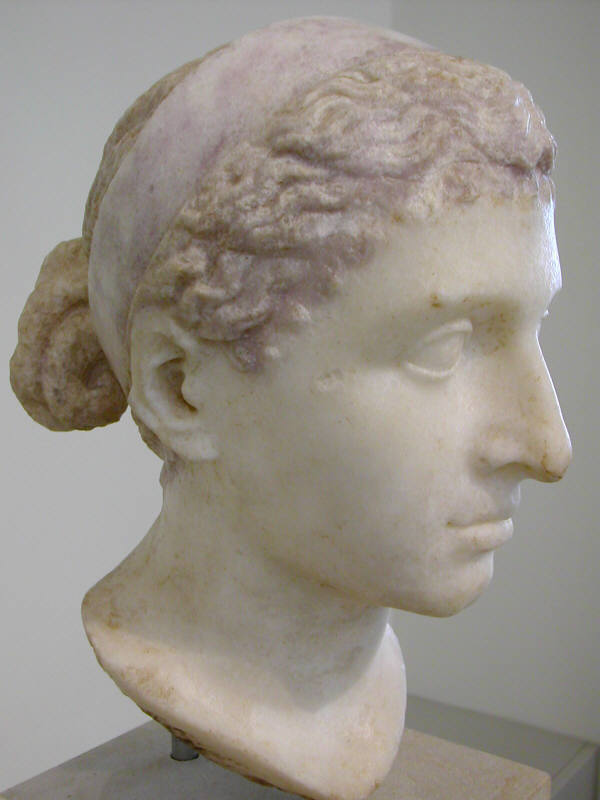
   If the story of her being carried in to Julius Caesar on the shoulder of a servant is true—and it sounds to have been, as she needed to be smuggled behind enemy lines to meet Caesar—Cleopatra was relatively small. Some four or five marble busts are thought to represent her, though they collectively establish little more than that she wore her hair in tight corkscrew curls, that she appeared before her subjects with a white ribbon, or diadem, tied around her head, and that she had prominent cheekbones and a hooked nose. The coin portraits are more explicit. Even allowing for inexpert engraving and for a certain authoritative posturing, Cleopatra had a lean face, angular and alert. The chin was sharp and prominent, the eyes sunken.


  A Greek woman steeped in Greek culture in a Greek-inflected city, Cleopatra wore tunics and mantles, ankle-length and artfully draped. They were lavishly colored, in an array of mauves, blues, and reds, and made of diaphanous Chinese silk or gauzy linen, occasionally shot through with golden thread. Traditionally those robes were worn belted, or held tight to the body with a brooch or ribbon under the breast. Over the tunic went a long cloak, often a transparent one, through which the folds of the brilliant bottom fabric could be seen. A shawl or short cape might be added around the shoulders. On her feet Cleopatra wore sandals of woven palm, jeweled and with fantastically patterned soles. (At dinner parties, fragrances rippled from those soles, as from jewelry and lamps.) She may have toned down the wardrobe in Rome, on every count a less colorful city than was Cleopatra’s Alexandria.


    Pearls topped the extravagance scale in the first century BC. They were the diamonds of the day. Rich, profligate people were said to gulp them down, in the classical version of burning dollar bills. Cleopatra would be accused of doing so as well, without any basis in fact, though she certainly wore plenty of pearls. She coiled ropes of them around her neck and braided more into her hair. She wore others sewn into the fabric of her tunics. By the time a first century AD chronicler got his hands on her story, Cleopatra owned earrings made of the two largest pearls “in the whole of history.” He assigned each an astronomical value; it was as if Cleopatra dangled a luxurious Mediterranean villa from each ear.


   There would have been a great deal of additional jewelry. Ornamentation was so much the order of the day that the walls of Cleopatra’s palace, the tumblers and goblets on her table, the couches in her receiving rooms were studded with gems. Egyptian taste ran to bright semiprecious stones—agate, lapis, amethyst, carnelian, garnet, malachite, topaz—set in gold pendants; intricately worked bracelets; long, dangling earrings. It has changed remarkably little: The cobra armlets we know today were in production in Cleopatra’s time. Of the countless beauty cures attributed to her—the asses’ milk baths, the gold facials, the mud treatments, the mint soufflé masks—we have not a shred of evidence whatsoever.


   Two contradictory accounts of Cleopatra’s last days have come down to us. She met the Roman general who defeated her either groomed to perfection—superbly turned out in mourning robes, which, as the historian Cassius Dio had it, “wonderfully became her”—or frail and disheveled, clad in a simple tunic, without so much as a respectable mantle. When she died, days later, she did so majestically: in formal, sumptuous robes, meticulously made up and expertly coiffed, a diadem wound around her forehead, the traditional crook and flail of an Egyptian pharaoh tight in her hands. She was 39, and had ruled Egypt, mostly alone, from the age of 18 - Will the real Cleopatra please stand up? by Stacy Schiff


Read More http://www.wmagazine.com/beauty/2010/10/cleopatra_a_life#ixzz1G6Si6Npf


Woman of the Week : Cleopatra

   What do you know about Cleopatra?  Over time, people have seen Cleopatra as a ravishing beauty...a greedy power-monger...a goddess...a queen...a courageous leader...a seducer and destroyer of great men. Which of these portrayals is true?


Much of what we know about Cleopatra was written after her death when it was politically expedient to portray her as a threat to Rome and its stability. Thus, some of what we know about Cleopatra may have been exaggerated or misrepresented by those sources. Cassius Dio, one of the ancient sources that tell her story, summarizes her story as "She captivated the two greatest Romans of her day, and because of the third she destroyed herself."

Early Years

During Cleopatra's early years, her father tried to maintain his failing power in Egypt by bribing powerful Romans. Ptolemy XII was reportedly the son of a concubine instead of a royal wife.
When Ptolemy XII went to Rome in 58 BCE, his wife, Cleopatra VI Tryphaina, and his eldest daughter, Berenice IV, assumed the rulership jointly. When he returned, apparently Cleopatra VI had died, and with the help of Roman forces, Ptolemy XII regained his throne and executed Berenice. Ptolemy then married his son, about 9 years old, to his remaining daughter, Cleopatra, who was by time about eighteen.

Early Rule

Cleopatra apparently attempted to rule alone, or at least not equally with her much-younger brother. In 48 BCE, Cleopatra was pushed out of power by ministers. At the same time, Pompey -- with whom Ptolemy XII had allied himself -- appeared in Egypt, chased by forces of Julius Caesar. Pompey was assassinated by Ptolemy XIII's supporters. A sister of Cleopatra and Ptolemy XIII declared herself ruler as Arsinoe IV.

Cleopatra and Julius Caesar

Cleopatra, according to the stories, had herself delivered to Julius Caesar's presence in a rug and won his support. Ptolemy XIII died in a battle with Caesar, and Caesar restored Cleopatra to power in Egypt, along with her brother Ptolemy XIV as co-ruler.
In 46 BCE, Cleopatra named her newborn son Ptolemy Caesarion, emphasizing that this was the son of Julius Caesar. Caesar never formally accepted paternity, but he did take Cleopatra to Rome that year, also taking her sister, Arsinoe, and displaying her in Rome as a war captive. That he was already married (to Calpurnia) yet Cleopatra claimed to be his wife added to a climate in Rome that ended with Caesar's assassination in 44 BCE.
After Caesar's death, Cleopatra returned to Egypt, where her brother and co-ruler Ptolemy XIV died, probably assassinated by Cleopatra. She established her son as her co-ruler Ptolemy XV Caesarion.

Cleopatra and Marc Antony

When the next Roman military governor of the region, Marc Antony, demanded her presence -- along with that of other rulers who were controlled by Rome -- she arrived dramatically in 41 BCE, and managed to convince him of her innocence of charges about her support of Caesar's supporters in Rome, captivated his interest, and gained his support.
Antony spent a winter in Alexandria with Cleopatra (41-40 BCE), and then left. Cleopatra bore twins to Antony. He, meanwhile, went to Athens and, his wife Fulvia having died in 40 BCE, agreed to marry Octavia, the sister of his rival Octavius. They had a daughter in 39 BCE. In 37 BCE Antony returned to Antioch, Cleopatra joined him, and they went through a sort of marriage ceremony in 36 BCE. That same year, another son was born to them, Ptolemy Philadelphus.
Marc Antony formally restored to Egypt -- and Cleopatra -- territory which the Ptolemy's had lost control of, including Cyprus and part of what is now Lebanon. Cleopatra returned to Alexandria and Antony joined her in 34 BCE after military victory. He affirmed the joint rulership of Cleopatra and her son, Caesarion, recognizing Caesarion as the son of Julius Caesar.
Antony's relationship with Cleopatra -- his supposed marriage and their children, and his granting of territory to her -- was used by Octavian to raise Roman concerns over his loyalties. Antony was able to use Cleopatra's financial support to oppose Octavian in the Battle of Actium (31 BCE), but missteps -- probably attributable to Cleopatra -- led to defeat.
Cleopatra tried to get Octavian's support for her children's succession to power, but was unable to come to an agreement with him. In 30 BCE, Marc Antony killed himself, reportedly because he'd been told that Cleopatra had been killed, and when yet another attempt to keep power failed, Cleopatra killed herself.

Egypt and Cleopatra's Children After Cleopatra's Death

Egypt became a province of Rome, ending the rule of the Ptolemies. Cleopatra's children were taken to Rome. Caligula later executed Ptolemy Caesarion, and Cleopatra's other sons simply disappear from history and are assumed to have died. Cleopatra's daughter, Cleopatra Selene, married Juba, king of Numidia and Mauretania.
-about.com

Monday, 7 March 2011

International Women's Day Centenary (1911-2011)


International Women's Day is a global celebration of the economic, political and social achievements of women -- past, present and future. The first International Women's Day events were run in Austria, Denmark, Germany and Switzerland in 1911 and attended by over one million people. 100 years on, International Women's Day (IWD) has become a global mainstream phenomena celebrated across many countries and is an official holiday in approximately 25 countries, including Afghanistan, Russia, Ukraine, Vietnam and Zambia.Take a moment to contemplate; just a couple generations ago, women could not work, vote, leave a marriage or even have a say in the fate of their children.


.

Thus Spoke Scheherazade

This blog is in homage to Real Women who do not have to rely on their beauty alone to reap the grandeurs of this world, but women who can conquer kings with Wisdom and Intelligence. The Woman in all of us dying to Shine in life and Flourish in the world. Brave and Bold, fearing none these women seek to challenge the very fabric of our existence in a world fraught full of inequality, these women dare to live a life of their own, with the sacredness of the divine feminine they seek for a just world and a patient and peaceful existence with all the creations of this earth, especially when it comes to loving our other halves. This blog also is laced with the little things in life that I find thrilling, the many mundane graces and gifts in life that every woman should possess and be aware of, from tips and tricks to reviews and questions that none dare answer. Scheherazade is my chosen muse and an inspiration to this blog, for she used a woman’s greatest weapon to find freedom and love: Herself!